
Thailand Trademark Search: Step-by-Step Guide to the DIP Database (2026)
Published · Khonsu Legal
You can search Thailand's trademark register yourself, free, at the Department of Intellectual Property (DIP): the main database at search.ipthailand.go.th/trademark, plus two AI-powered tools DIP launched in February 2026 — AI Image Search (upload your logo, get visually similar marks) and Trademark Checker (a guided registrability check connected live to the register). This guide walks through each one step by step, shows how to read the results, and explains the searches most DIY users miss: Thai transliterations, phonetic near-matches, and pending applications.
One thing to know before you start: Thailand is a first-to-file country. With narrow exceptions, rights belong to whoever files first — not whoever used the name first. That makes the search-before-filing step more important here than in first-to-use countries, and it makes an unsearched brand launch a genuine legal risk.
Why search before filing (or before launching a brand)?
Three practical reasons:
- Your application will be examined against existing marks. Registration takes roughly 10–18 months in the normal track; discovering a conflicting mark at month nine wastes the fee and the year.
- Using a mark that infringes a registered one is a liability from day one — rebranding after you have printed packaging, registered a company name and built a website costs far more than a search.
- The register tells you about your competitors — what they have protected, in which classes, and where the gaps are.
Where is the DIP trademark database — and is it in English?
The register is searchable at:
- search.ipthailand.go.th/trademark — the main trademark search (marks, owners, classes 1–45, application status)
- tmsearch.ipthailand.go.th — the goods and services (classification) look-up tool
The interface is primarily in Thai. Some screens and the DIP's English-language pages help with orientation, but for serious searching you will be working with Thai-language fields and results — one reason professional searches exist. The steps below work regardless.

How do I search the DIP database step by step?
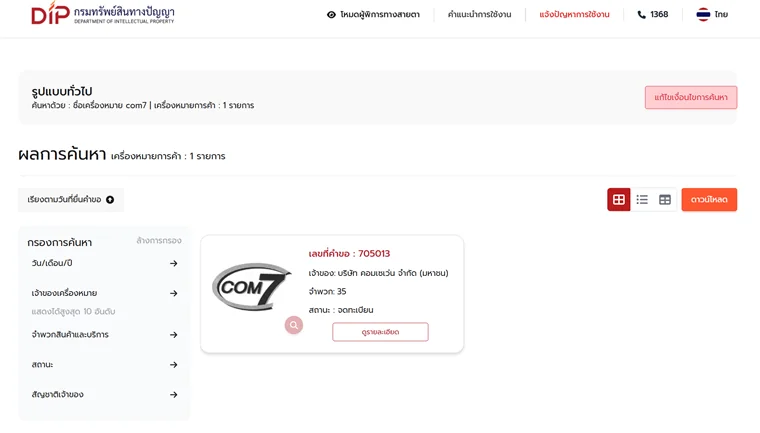
Step 1 — Search the exact word mark. Enter your brand name in Latin characters in the mark field. Search with no class filter first: a well-known mark — a protected status under Thai trademark law — can block you even in another class.
Step 2 — Repeat in Thai script. Search the Thai transliteration(s) of your name (see the transliteration section below — this is the step DIY searches most often skip).
Step 3 — Filter by your Nice class. Re-run both searches filtered to the class(es) your goods or services fall in, plus any neighbouring class a competitor would realistically file in.
Step 4 — Broaden to partial and phonetic matches. Search the distinctive part of your name alone (for "SIAMSPICE", search "SIAM" + class filter and "SPICE" + class filter), and obvious spelling variants (C/K, S/Z, single/double letters).
Step 5 — Record what you find. For each hit, note the mark, owner, application number, class, the goods/services description, and — critically — the status.
How do I use DIP's new AI tools (2026)?
In February 2026 DIP opened two free tools that materially change the search workflow:
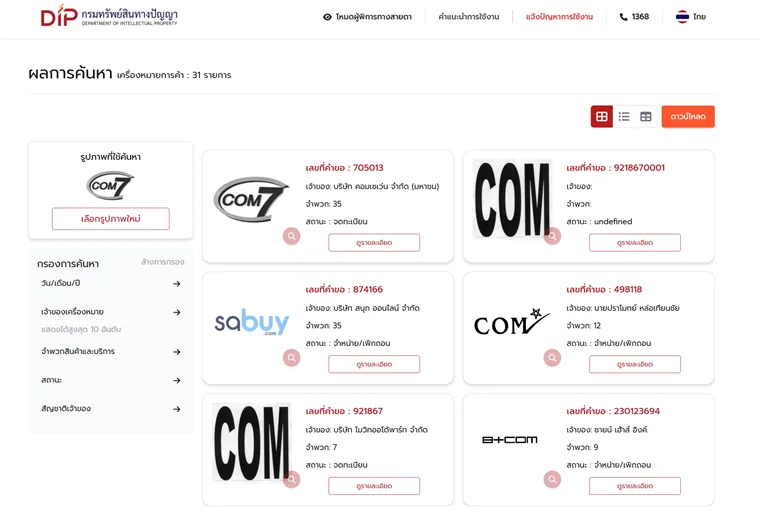
AI Image Search — tm-imagesearch.ipthailand.go.th. Upload an image of your logo or device mark; the system returns registered and pending marks it assesses as visually similar. This was previously the hardest search to do without professional software — word marks are typeable, logos are not. Use it for any mark with a graphic element, and treat the results as a candidate list to review, not a verdict.
Trademark Checker — tm-checker.ipthailand.go.th. A guided check connected live to the register: it looks for identical and similar marks already on file and gives a preliminary view on whether your mark is likely to register. It is the best starting point for a first-time filer — with the caveat that "preliminary" means exactly that: the examiner, not the Checker, decides.
Both tools are free and available around the clock.
How do I search Thai transliterations and similar-sounding marks?
This is where most self-searches fail. Thai applicants frequently register the Thai-script version of a foreign-sounding brand, and Thai examiners assess similarity by sound and meaning as well as appearance. A clear Latin-script search result can hide a blocking Thai-script mark.
Practical approach:
- Write out the standard Thai transliteration of your mark (there is often more than one plausible spelling — search each).
- Watch the classic ambiguities: R/L (โร/โล), V/W (วี), final consonant sounds that Thai renders differently, and long/short vowels that create two spellings of the same sound.
- Search meaning too: if your mark is a translatable word ("Sunrise", "Golden"), search its Thai translation — a same-meaning mark in the same class is a real conflict risk under Thai practice.
No Thai keyboard? Get the Thai spelling from a transliteration tool or translation app, verify it with a Thai speaker if you can, and paste it into the search field — and switch off the browser's auto-translate while working in the DIP system, because a translated page can garble what you type into Thai-script fields.
If any of these searches turns up a close call, that is the point to hand the file to a professional — judgement about "confusingly similar" in Thai is not a database skill.
Which Nice class should I search in?
Thailand uses the international Nice Classification: 45 classes (1–34 goods, 35–45 services). You search — and later file — per class, so getting the class right shapes everything after it. Quick reference for common Phuket and Bangkok businesses:
| Business | Typical classes |
|---|---|
| Restaurant / café | 43 (food services); 30 or 29 for packaged products |
| Hotel / villa rental | 43 (accommodation); 36 (real estate services) |
| Software / app | 9 (software); 42 (SaaS, development) |
| Clothing brand | 25 (apparel); 35 if you retail others' goods |
| Cosmetics / spa products | 3 (cosmetics); 44 (spa services) |
| Consulting | 35 (business), 36 (financial), 45 (legal) |
| Import–export trading | 35, plus the class of the goods traded |
The classification look-up at tmsearch.ipthailand.go.th shows the accepted goods/services wording — Thailand examines the item descriptions, so the wording you choose affects both the search and the government fee (see below).
How do I read the results — pending vs registered, similar vs identical?
- Registered marks are live rights. An identical or confusingly similar registered mark in your class (or covering related goods) is a blocking problem.
- Pending applications matter just as much: Thailand is first-to-file, so an application filed last month beats yours filed today, even though it is not yet registered. Never ignore hits with pending status.
- Refused, withdrawn or expired marks are informative, not blocking — though a recently expired mark can sometimes be restored, so note the dates.
- Similarity is assessed on look, sound and meaning combined with the overlap in goods/services. Identical name + different, unrelated class is often fine; similar-sounding name + overlapping class is often not. The grey zone in between is precisely what examiners and IP lawyers argue about.
Three things this search does not tell you: whether the name is free as a company name (that is the DBD's separate register) or as a domain; whether an unregistered but well-known mark could still stand in your way; and whether the mark is registrable at all on absolute grounds (next section). International (Madrid) registrations designating Thailand do appear in the DIP system — the IRN field in the search form exists for exactly that.
Can a name nobody has taken still be refused?
Yes — availability is only half of registrability. Thai examiners also refuse marks on absolute grounds: words that merely describe the goods or services ("Best Coffee" for a café), generic terms, geographic names — "Phuket" inside a mark for Phuket-based services is a common casualty — surnames presented plainly as surnames, and anything resembling royal, state or official emblems. If your mark is descriptive, the usual fixes are a distinctive logo treatment, a coined or invented element, or evidence of acquired distinctiveness through long use. Run this test alongside the availability search, not after it.
The search pitfalls checklist
Run your eye down this list before you conclude a name is free — every item is a mistake we have seen turn into an office action or a dispute:
- Searched Latin script only. Thai-script registrations of the same or similar-sounding name will not appear. Always run the Thai transliteration searches.
- Ignored pending applications. First-to-file means a pending application beats you. Pending status is a conflict, not a footnote.
- Searched only your exact class. Similar goods in a neighbouring class can block you — a class 30 food product and a class 43 restaurant with the same name are closer than the class numbers suggest.
- Searched the full name but not its distinctive part. "PHUKET GOLDEN SPICE CO." clears; "GOLDEN SPICE" in the same class is registered. The distinctive element is what gets compared.
- Word search for a logo mark. A device mark's conflicts are visual. Until 2026 this genuinely required professional tools; now run it through DIP's AI Image Search at minimum.
- Ignored meaning. A Thai-language mark that translates to the same word as yours, in the same class, is a real similarity risk under Thai practice.
- Treated "expired" as "gone". Note the dates — recently lapsed marks can sometimes be restored, and the former owner may still be trading under the name.
- Sat on a clear result. A clearance is a snapshot of the register on the day you ran it. In a first-to-file system, the gap between searching and filing is unprotected time.
What should I do if I find a conflicting mark?
Options, in the order we usually consider them:
- Adjust the goods/services description to avoid the overlap, where your real business allows it.
- Modify the mark — adding a distinctive element sometimes clears a mid-strength conflict (and sometimes does not; this is judgement territory).
- Coexistence or consent — approach the owner, but know the limits. The Registrar generally does not accept a letter of consent to overcome a similarity objection at examination; it accepts one mainly where the marks came from a common owner through assignment or inheritance. A consent letter can still help as evidence of honest concurrent use or special circumstances under section 27, and on appeal to the court.
- Challenge the blocking mark — non-use cancellation is available against a mark with no genuine use in the three years before the cancellation petition, and oppositions can be filed against pending applications during the 60-day publication window.
- Rebrand — cheapest when done before launch, which is the whole argument for searching early.
What comes after a clear search?
File promptly — a clear search result has a shelf life in a first-to-file system. The essentials for filing in Thailand:
| Item | Detail |
|---|---|
| Government filing fee | ฿1,000 per item of goods/services (1–5 items); ฿9,000 flat per class for more than 5 items |
| Registration fee (on allowance) | ฿600 per item (1–5); ฿5,400 flat per class for more than 5 items |
| Typical timeline | ~10–18 months filing to registration (examination, 60-day publication, registration) |
| Accelerated route | "Fast Track 4 Month Plus+" — a narrow e-commerce route only (one class, up to 10 items, e-filing, no post-filing amendments), open since 1 January 2026, with the first examination result due within 4 months of filing |
| Term | 10 years from filing, renewable indefinitely |
A foreign applicant needs a Thai agent and address for service — in practice, a signed power of attorney (notarised when signed abroad) plus the applicant's name, address and a clear representation of the mark. This is where our trademark and IP practice comes in: we run the professional clearance search (including the Thai-script and phonetic layers), advise on classes and item wording, file, and handle office actions through to registration.
This article is general guidance — not legal or tax advice. If you'd like a scoped opinion on how it applies to your specific situation, contact our team.
Frequently asked
Is the DIP trademark search free?
Yes — the main database and both 2026 AI tools are free public services. You pay government fees only when you file.
Can I search in English?
You can type Latin-script marks into the search, but the interface and much of the data are in Thai, and Thai-script marks will not surface unless you search them in Thai. An English-only search is a partial search.
Is a DIY search enough before filing?
It is enough to kill obviously taken names cheaply. It is not a clearance opinion: it will miss phonetic Thai conflicts, meaning-based conflicts and judgement calls on similarity. Our usual advice — do the DIY search first, then have the survivors professionally cleared.
Someone is using my brand in Thailand but I never registered it. Am I protected?
Mostly no. Thailand is first-to-file; unregistered marks have only narrow protection (for example, well-known marks and passing-off-type claims). If the brand matters, register it — and search first.
How long does registration take?
Roughly 10–18 months in the normal track. The Fast Track 4 Month Plus+ route is faster but narrow — it is limited to e-commerce filings in one class with up to 10 items. Either way, the 10-year term is counted from the filing date — enforcement rights only arise once the mark actually registers, but the term you eventually receive is not shortened by the examination wait.
What does a professional clearance search add over the free DIP tools?
Three things: the Thai-language layer (transliterations, phonetic variants and translations searched systematically, by a native reader); a similarity judgement calibrated to how Thai examiners and courts actually decide borderline cases; and a written opinion you can act on — including, when the result is a near-miss, a concrete strategy (rewording the goods, adjusting the mark, consent, or a cancellation action) rather than a raw list of hits.
Should I register the Thai-script version of my mark too?
Often yes. If customers will see or say your brand in Thai, a separate Thai-script registration closes the gap an imitator would otherwise use. Many established brands in Thailand hold both versions.
Do I need to be in Thailand to file?
No, but a foreign applicant files through a local agent with a Thai address for service. We handle this for clients as part of our trademark service.
Ready to take the next step?
Schedule a consultation with our multilingual legal and accounting team.